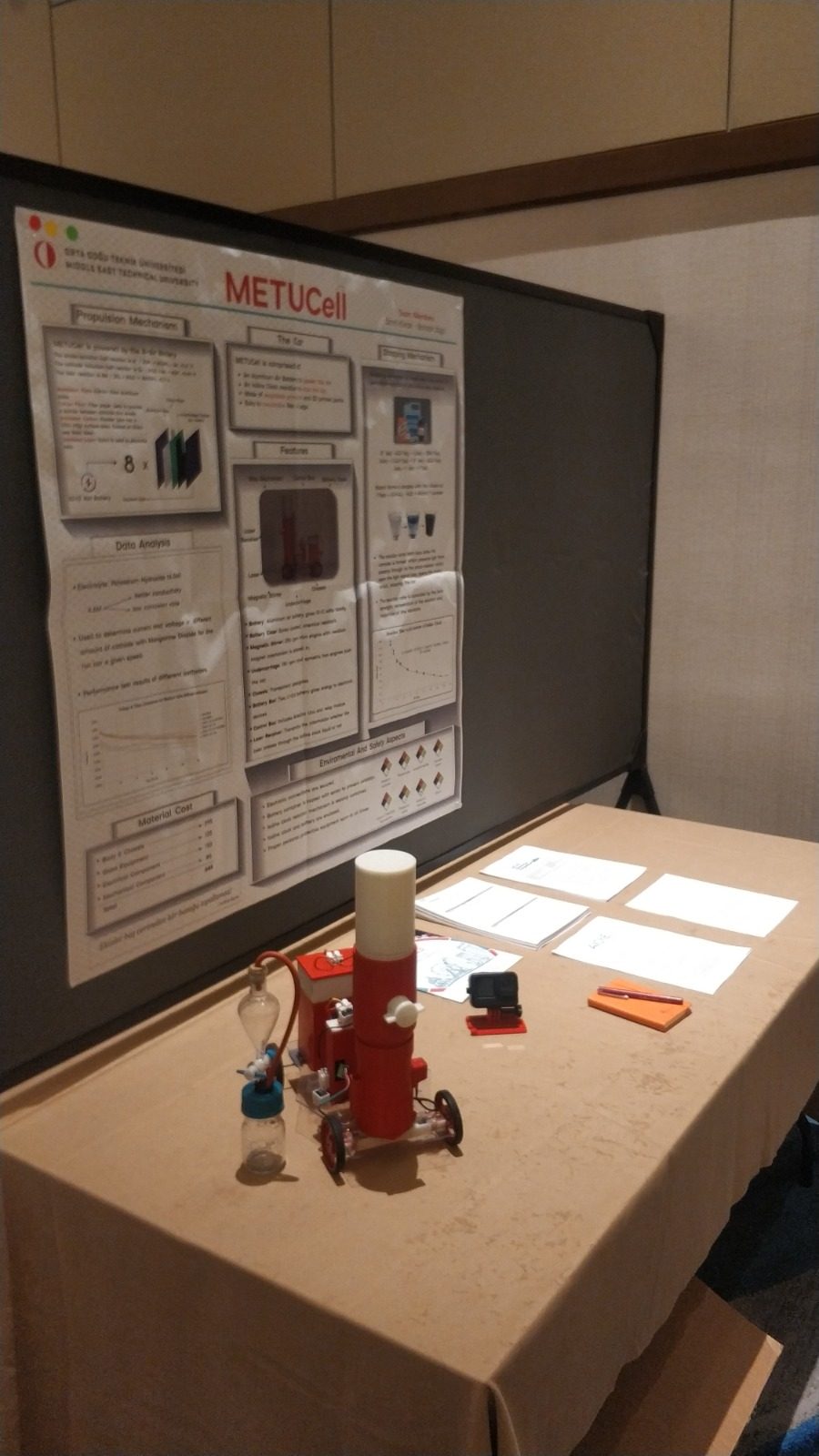
Chem-E-Car
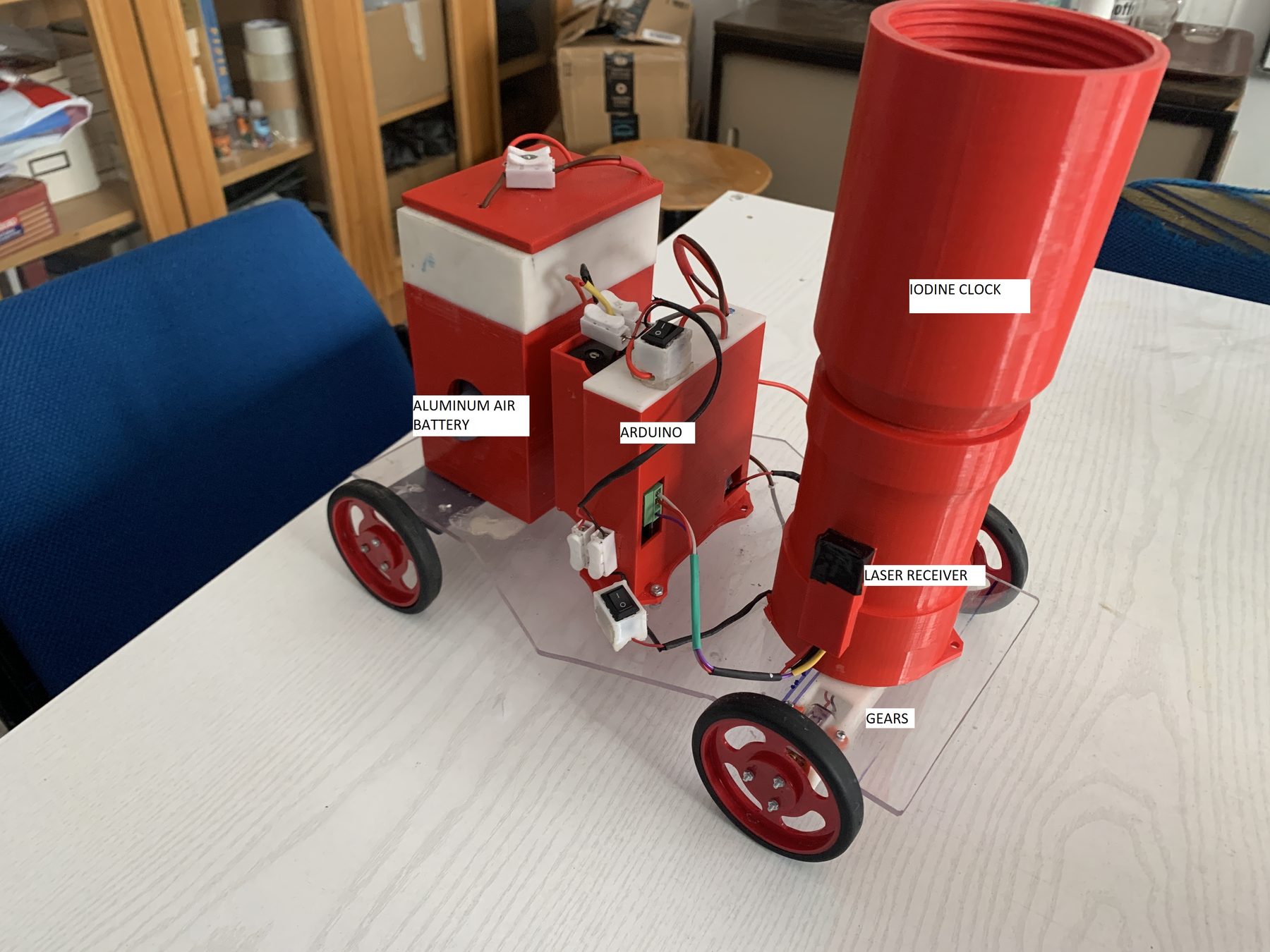
A small car that moves on chemistry and stops on chemistry: powered by an aluminium–air battery and halted by an iodine clock reaction, built with our AIChE student chapter.
- Event
- AIChE Chem-E-Car Competition, 2023 (USA)
- Team
- AIChE student chapter
- Power
- Aluminium–air battery
- Stopping mechanism
- Iodine clock reaction + laser sensor
- Electronics
- Arduino-controlled relay
In 2023 we represented our AIChE student chapter at the Chem-E-Car competition, held every year by the American Institute of Chemical Engineers. The rules are simple and brutal: the car must be driven by a chemical process and stopped by a chemical process, and it has to cover a distance that is announced only half an hour before the run.
How it works
The car is powered by an aluminium–air battery. To stop it, we used an iodine clock reaction: a clear solution that suddenly turns dark after a delay set by the reactant concentrations. A laser shines through the reaction chamber onto a receiver. The moment the solution turns black, the beam is blocked and an Arduino opens the relay connected to the battery — the car stops.
What went wrong — and what we learned
Our preparation experiments had been run with old, aged chemicals. At the competition in the United States we worked with fresh reagents from different manufacturers and at different purities, which made re-calibrating the iodine clock timing much harder. On top of that, a drop in battery performance changed the motor RPM, and we finished well down the rankings. The lesson stuck: a chemical timer is only as good as the consistency of its chemicals, and the power source needs the same attention as the stop mechanism.
At the competition