Chemical Engineering
Handbook
Industrial reactor problems worked through from first principles: chemistry, equilibrium and kinetics, the balance equations and their numerical solution, with Python and MATLAB code for every case.
Worked models
Each model begins with a design problem and solves it for several reactor configurations, so the results can be compared side by side. Assumptions, data sources and code are given in full.
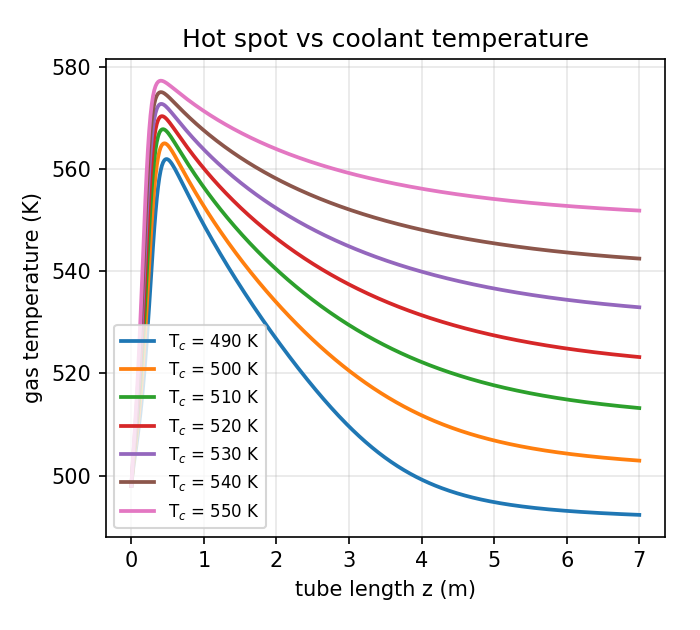
Methanol reactor modeling
Quench converter, boiling-water-cooled tubular reactor and the full synthesis loop with recycle and purge, on Vanden Bussche–Froment kinetics.
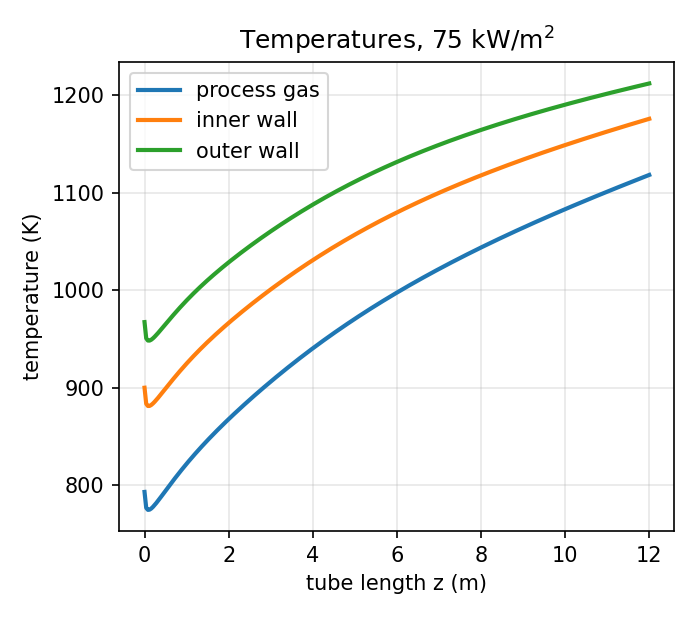
Steam reforming reactor modeling
The equilibrium limit, a fired reformer tube with wall temperatures and pressure drop, and an autothermal reformer, on Xu–Froment kinetics.
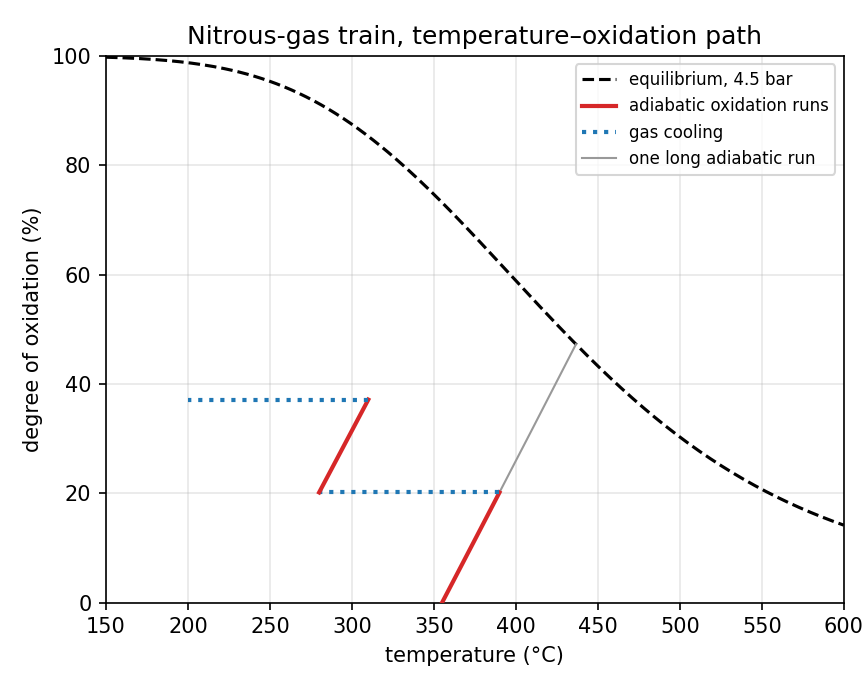
Nitric acid process modeling
The Ostwald process in a dual-pressure plant: adiabatic ammonia burner, third-order NO oxidation with N₂O₄ and N₂O₃, and the nitrous-gas train checked against the flow sheet.
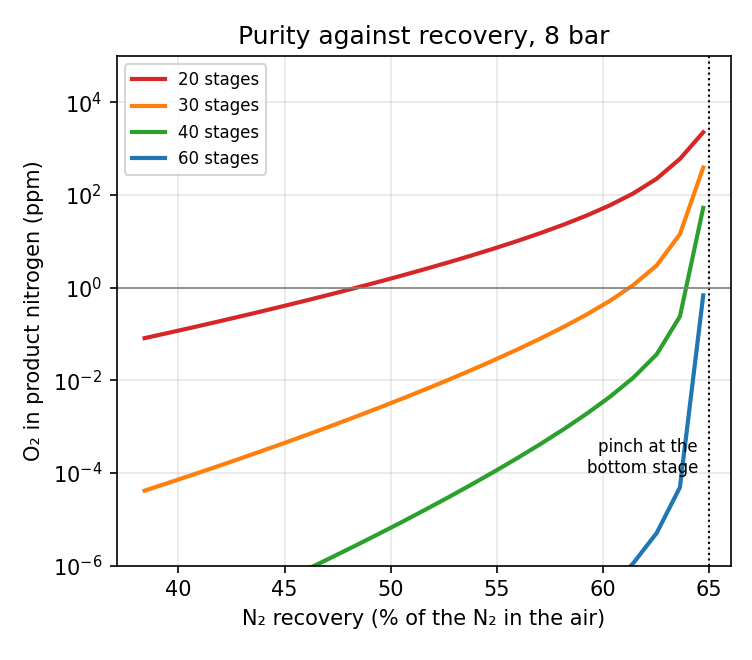
Air separation modeling
Nitrogen from air three ways: the phase equilibrium of liquid air and the double-column pressures, a single cryogenic column solved stage by stage, and a hollow-fibre membrane unit.
In preparation
Nitrous-gas absorption tower
Plate-to-plate model of NO₂/N₂O₄ absorption with oxidation spaces between the sieve trays.
Double column and argon recovery
HP and LP columns coupled through the main condenser, with the crude-argon side column.
SO₂ oxidation in a four-bed converter
Adiabatic beds, inter-pass absorption and the approach to equilibrium.
CSTR multiplicity and stability
Heat generation and removal lines, ignition, extinction and dynamics.
Binary distillation, stage by stage
McCabe–Thiele, then rigorous MESH equations for the same column.
Transient heat conduction
Finite-difference solution of a cooling slab and cylinder, compared with Heisler charts.
Sources and verification
Kinetic and thermodynamic data are taken from the published literature — the primary papers, the reaction-engineering textbooks and the Ullmann's Encyclopedia articles on each process — and cited in the text where they are used. Every model is written in both Python and MATLAB and the two versions are checked against each other and against published equilibrium data; the MATLAB files also run in GNU Octave.