Single-Piece Orifice Flowmeter
An orifice-type flowmeter for flows up to 80 Nm³/h, machined as a single piece on a lathe, designed around ISO 5167-2 and calibrated for use in the rocket feed system.
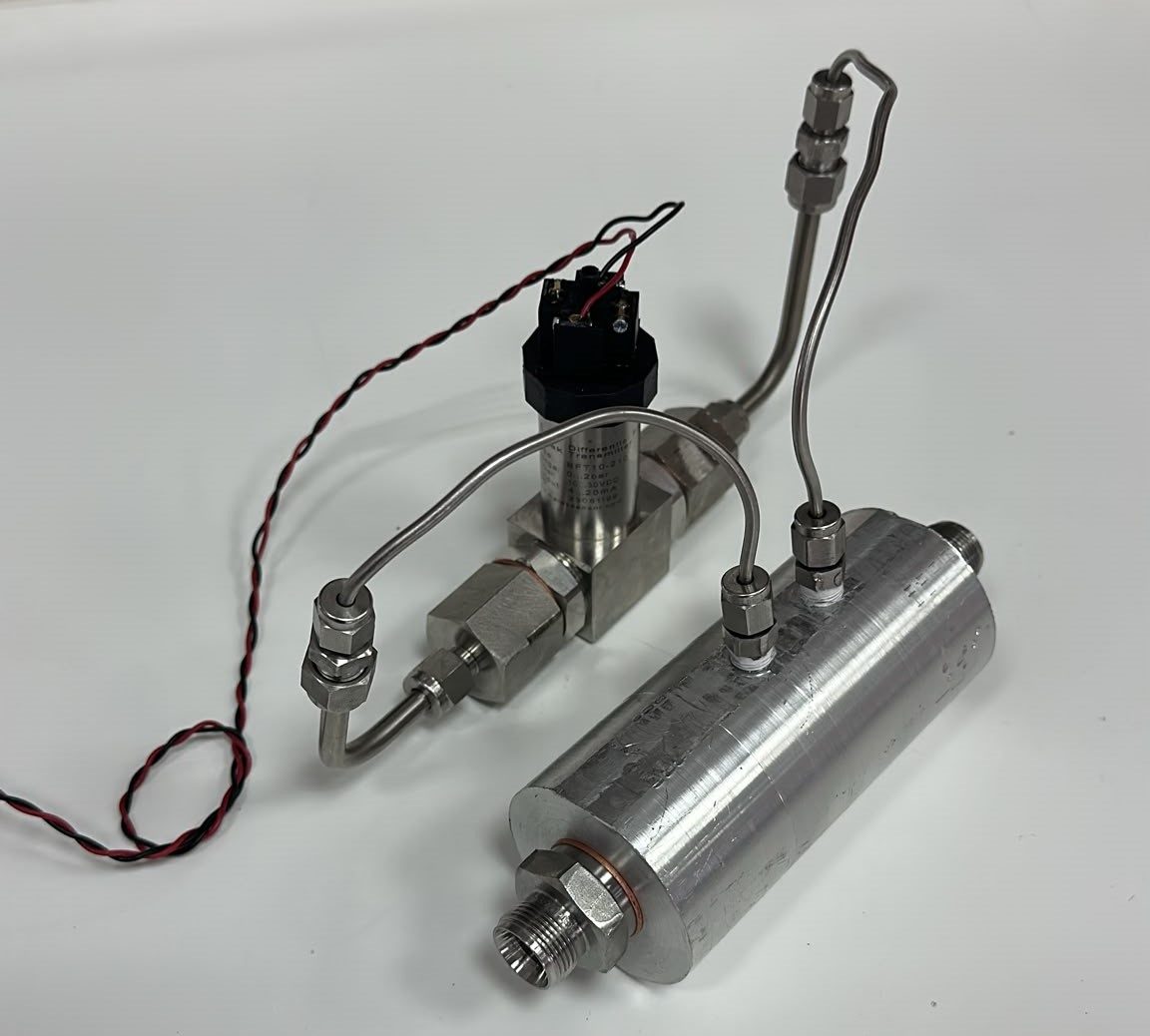
- Design flow
- 80 Nm³/h
- Standard
- Designed following TS EN ISO 5167-2
- Construction
- Single piece, lathe-turned
- Instrumentation
- 2 bar differential pressure transmitter
- Flow coefficient
- Cv 1.32 theoretical · 1.23 measured
- Used in
- B3 Liquid Rocket Feed System
Flowmeters are expensive; an orifice plate is just a precisely made hole. For this project I turned a complete orifice-type flowmeter from a single piece of metal on a lathe, sized to measure gas flows of around 80 Nm³/h.
Machining details that matter
The design follows TS EN ISO 5167-2 as closely as the method allows (ISO 5167-1, 2003; ISO 5167-2, 2003). The hardest part was the orifice's sharp upstream edge — the standard expects a knife-sharp corner, and producing one on an old lathe, inside a one-piece body, is not easy. The pressure tapping channels were kept as small as possible.
Because the orifice edge is not as sharp as a thin plate, the downstream pressure is taken through a 1 mm hole placed immediately after the orifice. This keeps the response as linear as possible across different flow rates.
Calibration
Measurements were taken with a 2 bar differential pressure transmitter. The theoretical flow coefficient came out at Cv = 1.32, and the experimentally measured value was Cv = 1.23 — within about 7 %. A difference of this size is expected when the edge is not perfectly sharp and the tappings differ from the standard ones, because the discharge coefficient of the standard applies only to its prescribed geometry (ISO 5167-2, 2003; Reader-Harris, 2015). With its calibration data, the meter went straight into service on the rocket feed system.
References
- ISO (2003). ISO 5167-1: Measurement of fluid flow by means of pressure differential devices inserted in circular cross-section conduits running full — Part 1: General principles and requirements. International Organization for Standardization, Geneva.
- ISO (2003). ISO 5167-2: Measurement of fluid flow by means of pressure differential devices inserted in circular cross-section conduits running full — Part 2: Orifice plates. International Organization for Standardization, Geneva.
- Reader-Harris, M. (2015). Orifice Plates and Venturi Tubes. Springer, Cham (Experimental Fluid Mechanics series).